
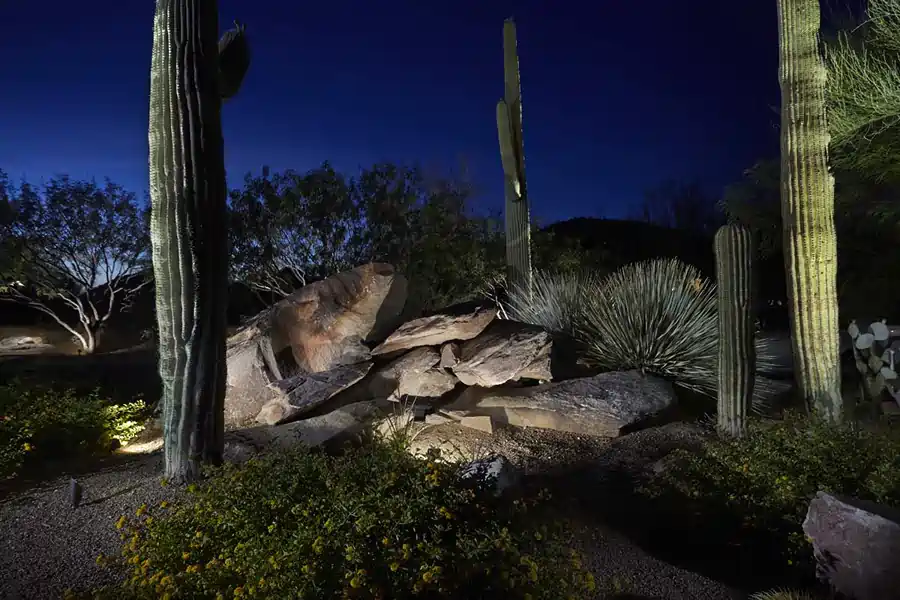
The outdoor spaces that feel best after dark are rarely the brightest ones. Good landscape lighting in Tucson uses layers of controlled light to guide movement, reveal architecture and planting, and create enough contrast for the landscape to retain its character at night.
For both residential and commercial properties, the key is to think beyond individual fixtures. Path lighting, accent lighting, ambient light, architecture, planting, hardscape, and the way people move through the property should all be considered together. Done well, the lighting feels almost effortless. You notice the landscape, not the equipment illuminating it.
That is what gives a thoughtfully designed property the relaxed, composed feeling people often associate with a high-end resort.
What Does Layered Outdoor Lighting Mean?
Layered lighting means using different types of light for different purposes rather than asking one fixture or one lighting technique to illuminate an entire space.
Three layers are particularly important in landscape design: path lighting, accent lighting, and ambient lighting.
Path Lighting: Helping People Move Comfortably
Path lighting provides visual guidance around walkways, stairs, grade changes, entries, courtyards, patios, and other circulation areas.
The objective is not to outline every walkway with a continuous row of fixtures. In fact, repeating path lights at equal intervals can quickly create the familiar “runway” effect.
A more natural approach considers where illumination is genuinely useful. Changes in elevation, turns in a path, steps, thresholds, and intersections usually deserve more attention than long, predictable stretches of walkway.
For a residential property, that might mean subtly guiding someone from the driveway to the front door or from the house to a pool or outdoor dining area. On a commercial property, the same layer can help define primary pedestrian routes, entrances, gathering areas, and transitions between different parts of the site.
Accent Lighting: Deciding What Deserves Attention
Accent lighting creates visual hierarchy.
A specimen tree, mature saguaro, sculptural plant, stone wall, water feature, artwork, or architectural detail can become a nighttime focal point when the light is positioned carefully.
Landscape Design West's Rooftop Retreat project is a good example of how strategic night lighting can use shadows, silhouettes, sculptural plants, and illuminated art to give an outdoor space an entirely different character after sunset.
This is particularly effective in southwest landscapes, where shape and texture are such important parts of the design. During the day, those qualities are revealed by strong desert sunlight. At night, controlled accent lighting can reinterpret the same landscape through highlights, silhouettes, shadows, and changes in depth.
The important part is selection. If every tree, wall, planter, and architectural element is highlighted equally, none of them remains a focal point.
Ambient Lighting: Creating the Background
Ambient lighting is the quieter layer that makes an outdoor environment feel comfortable.
It might come from concealed sources near a seating area, subtle wall lighting, illumination reflected from landscape elements, or architectural fixtures that provide a soft background level of light.
Unlike a spotlight, ambient light is not necessarily asking you to look at something specific. Its role is to help the space feel connected and usable.
When path, accent, and ambient lighting are balanced properly, the landscape has visual depth. Some features move forward, others recede, and darker areas are allowed to remain dark.
Why Does Some Landscape Lighting Feel Harsh?
Harsh lighting usually has less to do with the number of fixtures than with how the light is controlled.
Several problems appear repeatedly:
- Light sources are directly visible and produce glare.
- Fixtures are brighter than their purpose requires.
- Too many features receive the same level of emphasis.
- Beam angles are too broad and illuminate unintended areas.
- Path lights are repeated too frequently.
- Different color temperatures are mixed without a reason.
- Bright areas sit immediately beside very dark areas without a gradual transition.
- Fixtures are selected individually instead of as part of an overall plan.
One very common mistake is trying to eliminate darkness completely.
Darkness is not necessarily a flaw in outdoor lighting. It is part of the composition. Without darker areas, there is little contrast, and without contrast, illuminated trees, walls, water, or architectural details lose much of their impact.
A successful lighting plan decides what should be seen, what should be suggested, and what can remain in shadow.
Glare, Direction, and Color Matter More Than More Light
One of the simplest ways to improve an outdoor lighting plan is to control where the light actually goes.
The Five Principles for Responsible Outdoor Lighting developed by DarkSky and the Illuminating Engineering Society emphasize that outdoor light should have a clear purpose, be directed only where it is needed, be no brighter than necessary, be controlled when it is not needed, and favor warmer-colored light where possible.
Those principles also happen to support better-looking landscapes.
When the source of the light is concealed or properly controlled, your eye goes to the illuminated surface rather than the fixture itself. When unnecessary spill is reduced, textures and shadows become easier to appreciate. When color temperature remains consistent, the overall property feels more cohesive.
The goal is not simply illumination. It is visual comfort.
Residential Outdoor Lighting: Design Around How the Property Is Lived In
On a residential property, lighting should respond to daily routines as well as appearance.
Start by asking where people actually spend time after sunset.
For many Tucson homes, that may include:
- The route from the driveway to the front entrance
- Courtyards and entry gardens
- Patios and outdoor dining areas
- Pools and adjacent gathering spaces
- Outdoor kitchens
- Fire or water features
- Garden paths
- Views from major interior rooms
That final point is easy to overlook.
Landscape lighting is experienced from inside the house too. A beautifully illuminated tree framed through a living-room window can become part of the interior experience after dark. Conversely, a bright fixture directed toward a window can create glare and diminish the view.
A strong backyard design in Tucson should therefore consider nighttime sightlines early in the planning process, particularly when patios, large windows, glass doors, pools, focal planting, and outdoor gathering spaces are part of the composition.
Create Moments Rather Than Lighting Everything
A resort does not typically illuminate every square foot at the same intensity. Instead, it creates a sequence.
You might move from a softly illuminated entry toward a path where a mature tree becomes the focal point. Beyond it, a patio has a gentle ambient glow while the surrounding landscape becomes quieter and darker.
That progression creates discovery and depth.
The same idea can make residential landscapes feel much more intentional without adding visual clutter or unnecessary fixtures.
Commercial Outdoor Lighting: Design for Movement, Arrival, and Identity
Commercial landscape lighting has many of the same design principles as residential lighting, but the priorities can shift.
A commercial property may need to accommodate more users, clearer circulation, multiple approaches to the site, longer operating periods, or stronger relationships between landscape and building entrances.
Important areas may include:
- Main pedestrian approaches
- Primary entrances
- Courtyards and common areas
- Outdoor hospitality or seating spaces
- Landscape elements near building façades
- Architectural focal points
- Transition areas between parking and pedestrian zones
- Signature planting or landscape features that contribute to the property's identity
The lighting should still feel restrained. Increased activity does not mean every surface needs to be brightly illuminated.
For commercial projects in particular, landscape and architecture should read as one composition. A carefully illuminated entry tree, wall, planting mass, or architectural element can help establish arrival without competing with the building itself.
This is one reason working with a commercial landscape architect in Tucson can be valuable when exterior lighting forms part of a larger site design. Lighting decisions can be considered alongside circulation, planting, hardscape, architecture, views, and the experience of arriving at the property.
Tucson Landscapes Need Their Own Lighting Strategy
A Tucson AZ landscape has a visual language that is very different from a lush garden in a wetter climate.
Stone, gravel, masonry, steel, sculptural desert plants, mature trees, cacti, and open space all respond differently to light. Many of these materials and forms already have strong texture, so they rarely need aggressive illumination.
Consider a textured masonry wall, for example. Flooding it uniformly with light can flatten the surface. Light positioned more deliberately can reveal texture through subtle changes between highlight and shadow.
The same applies to desert plants.
A branching tree may benefit from lighting that reveals the structure of its canopy. A vertical cactus may work as a silhouette or focal point. A grouping of low plants may require little or no accent lighting if a nearby wall or tree already provides the visual anchor.
Good southwest landscaping designs use light selectively so the qualities that make desert landscapes distinctive are still present after sunset.
Outdoor Lighting Should Begin With the Landscape Plan
Lighting is much harder to integrate successfully when it is treated as something to add once the rest of the landscape has already been decided.
Ideally, it should be considered alongside:
- Circulation and pathways
- Outdoor rooms
- Plant placement
- Trees and focal specimens
- Walls and architectural elements
- Pools and water features
- Patios and gathering areas
- Views from inside the building
- Electrical requirements
- Access for future maintenance
A broader landscape master plan can help coordinate these decisions before individual elements are installed.
For anyone planning significant landscape design in Tucson, this integrated approach is particularly useful. The question is not simply where fixtures can be placed. It is what the property should feel like at night and which landscape elements are needed to create that experience.
A Practical Outdoor Lighting Checklist
Before finalizing a lighting plan, walk through these questions:
- Where do people move after dark?
Identify entrances, pathways, stairs, grade changes, and transitions between spaces. - Which features deserve to become focal points?
Choose a limited number of trees, architectural details, walls, sculptures, or water features. - Which areas can remain darker?
Deliberate darkness creates contrast and prevents the property from feeling overlit. - Can you see the light source?
Whenever possible, evaluate whether glare can be reduced through placement, shielding, aiming, or fixture selection. - Does the color of the light feel consistent?
Unplanned differences in color temperature can make an otherwise sophisticated landscape feel disconnected. - What does the landscape look like from inside?
Check important windows and doors, not only outdoor viewpoints. - Does the lighting suit the architecture?
Fixture style, visibility, brightness, and placement should support the property rather than compete with it. - How will the system be maintained?
Think about future access to fixtures as plants mature and the landscape changes. - Is every light doing something useful?
If a fixture has no clear purpose, reconsider whether it is necessary.
Why a Landscape Architect's Perspective Matters
Landscape lighting is not only an electrical or fixture-selection exercise. It is a spatial design problem.
A landscape architect in Tucson can look at lighting in relation to the entire property: how people circulate, which views matter, where the architecture establishes visual axes, which plants provide structure, and how gathering spaces connect to one another.
That broader perspective is useful for both residential and commercial properties because it helps keep lighting from becoming a collection of isolated effects.
The best results usually feel simpler than the work behind them.
Frequently Asked Questions About Outdoor Landscape Lighting
What makes outdoor lighting look high-end?
High-end outdoor lighting is generally characterized by restraint, consistency, and careful placement rather than sheer brightness. Light sources are controlled, focal points are selected intentionally, and darker areas are retained to create depth.
How many layers should landscape lighting have?
There is no ideal fixture count or formula for every property. Path, accent, and ambient lighting provide a useful framework, but the right combination depends on the architecture, circulation, landscape features, and ways the property is used after dark.
Should every tree be illuminated?
Usually not. Lighting selected trees creates hierarchy and allows important landscape elements to stand out. Illuminating every tree at a similar intensity can make the composition feel flat and overly busy.
Is landscape lighting different for residential and commercial properties?
The fundamental design principles are similar, but priorities can differ. Residential lighting tends to emphasize personal outdoor living, views from the home, entertaining, and arrival. Commercial lighting may place greater emphasis on pedestrian circulation, entrances, shared spaces, architectural identity, and the different ways visitors experience the property.
When should lighting be planned during a landscape project?
As early as practical. Integrating lighting with the overall landscaping design makes it easier to coordinate focal points, planting, pathways, walls, gathering areas, and views instead of trying to illuminate those elements after the design is complete.
A Better Nighttime Landscape Is Usually About Less, Not More
Creating outdoor spaces that feel calm, sophisticated, and resort-like does not require illuminating everything.
It requires deciding what matters.
A clear path, a beautifully revealed tree, a textured wall, a comfortable gathering area, and enough darkness between them can create far more atmosphere than a property filled with bright fixtures.
For residential and commercial landscapes alike, successful outdoor lighting comes from the same basic idea: use light deliberately, integrate it with the larger landscape design, and allow the nighttime character of the property to emerge rather than overwhelming it.
