
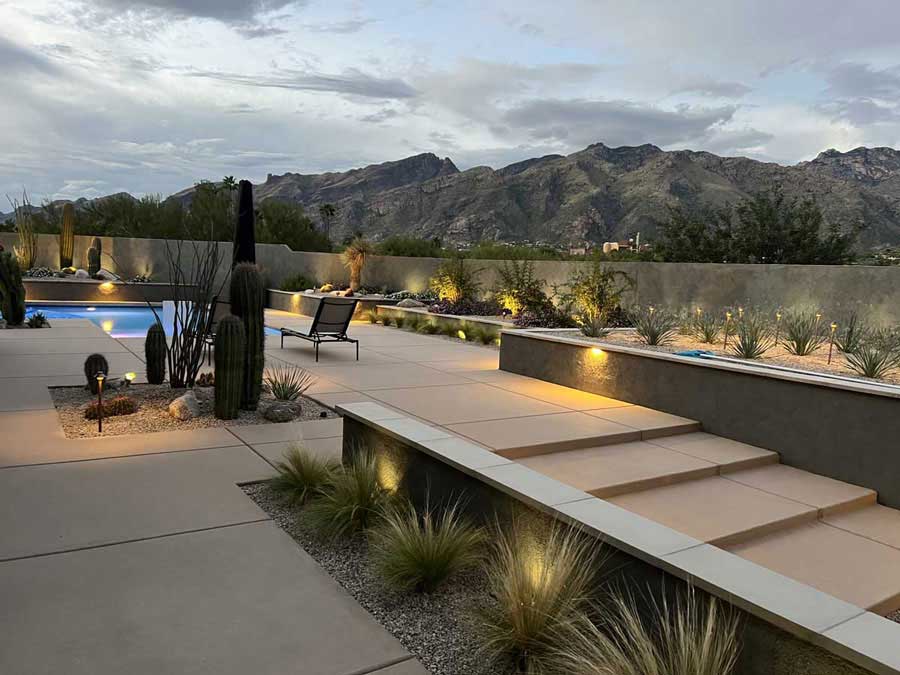
In Tucson, good landscaping design starts below the surface. Many plants fail here not because the plant label was wrong, but because the soil, root zone, grading, and irrigation plan were never aligned in the first place. In thoughtful landscape design Tucson homeowners and property managers need an establishment strategy that reflects how Sonoran Desert soils actually behave, not how we wish they behaved.
That is especially true for drought-tolerant plants. “Low water” does not mean “no planning.” In Tucson landscape, even resilient desert-adapted plants need the right soil conditions, deep enough wetting, oxygen around the roots, and enough time to establish before they can perform the way people expect.
University of Arizona Cooperative Extension notes that compacted soils limit water penetration, air exchange, and root growth, and that many desert plants perform poorly where water cannot move beyond the root zone. Caliche can create an additional barrier that traps water or blocks root expansion if it is not addressed correctly.
Why drought-tolerant plants still fail in Tucson
The common frustration is easy to recognize: the plant palette looks appropriate, the irrigation is “on,” and yet shrubs thin out, agaves stall, or young trees never seem to gain strength.
In most cases, failure has less to do with the drought-tolerant label and more to do with one or more of these conditions:
- Soil is compacted, so roots cannot move or breathe well
- Caliche or layered soil causes perched water or poor drainage
- Irrigation is too shallow and too frequent
- The planting hole acts like a basin that holds water differently than surrounding soil
- Establishment time was underestimated
- Plant selection did not match the specific microclimate or root-zone conditions
That practical, site-specific thinking fits Landscape Design West’s design philosophy. Their existing messaging emphasizes customized, sustainable design shaped by site analysis, environmental influences, and long-term outdoor living performance in the desert.
A quick definition of the terms that matter
Soil compaction
Compaction means soil particles are pressed so tightly together that water infiltration, air movement, and root growth are restricted. In desert landscapes, compaction is extremely common in built environments and often explains why plants struggle even with irrigation.
Caliche
Caliche is a hardened calcium carbonate layer common in Southern Arizona. It can restrict drainage and root growth. If a planting pit sits above caliche without a path for water to move through, roots may stay too wet in one zone and too dry in another.
Root zone
The root zone is the soil volume where roots actually grow and where irrigation needs to reach. Good irrigation design is not about wetting the surface. It is about wetting the intended root zone at the right depth and frequency.
Establishment
Establishment is the period when a new plant transitions from nursery conditions to the site. University of Arizona guidance notes that desert-adapted plants usually require supplemental irrigation for at least one growing season and may take roughly two to three years to be considered established.
What Tucson soils mean for irrigation design
A refined irrigation plan in Tucson landscapes should respond to soil behavior, not just plant type.
In practical terms, that means:
1. Depth matters more than surface appearance
If the top inch looks dry, that does not tell you whether moisture reached the active root zone. UA guidance for desert landscapes consistently emphasizes deeper, less frequent irrigation rather than light, frequent watering because shallow cycles encourage weak, surface-level roots.
2. Soil texture changes watering behavior
Clay-heavy or compacted soils accept water more slowly. Water may pond or run off before it reaches depth. Coarser soils drain faster and may need a different emitter layout or run time. The correct response is not simply “more water.” It is usually slower application, better spacing, cycle-and-soak timing, or a different hydrozone strategy.
3. Planting details affect performance for years
UA planting guidance warns against creating abrupt soil-texture transitions and notes that cultivation of compacted soils can improve properties and root growth. In other words, a plant that goes into a poorly prepared hole may live in a permanent mismatch between the planting zone and the surrounding site soil.
The real timeline most owners underestimate
One of the biggest planning errors in southwest landscaping designs is expecting a finished look too quickly.
New desert landscapes often move through three different visual phases:
Phase 1: Installation and early establishment
Plants may look sparse or static. This does not always signal failure. The priority is root initiation, not instant fullness.
Phase 2: Root expansion and adaptation
This is when irrigation discipline matters most. Overwatering can be just as damaging as underwatering because roots need oxygen as well as moisture.
Phase 3: Maturity and performance
Only after the plant has adapted to its soil volume, exposure, and irrigation pattern will it begin to behave like the drought-tolerant specimen people expected at purchase.
For many woody desert-adapted plants, that is not a few weeks. It is a multi-season process, and in some cases a two- to three-year establishment window is the more realistic expectation.
Soil-informed decision criteria for a better outcome
For high-value residential and commercial projects, the better question is not “What plants are drought tolerant?” It is “What will perform in this exact soil and irrigation condition over time?”
That is where a strong landscape architect Tucson approach becomes more valuable than a simple planting list.
Before finalizing a planting and irrigation plan, consider:
Existing soil conditions
Is the soil compacted, layered, or interrupted by caliche? Does water infiltrate evenly, or does it sit?
Root-zone volume
Is there enough usable soil for the mature plant, not just for the nursery container size?
Drainage behavior
Will the soil move water down and away, or will it hold water in pockets?
Irrigation delivery
Are emitters placed to encourage outward root growth over time? Can the system deliver deep watering rather than repeated shallow cycles?
Microclimate
Does the site reflect heat from walls, paving, or pool decks? Does it receive monsoon runoff, afternoon shade, or wind exposure?
Establishment expectations
Is the owner prepared for a realistic timeline and seasonal adjustment period?
These are the sorts of practical decision points that distinguish durable landscape designers Tucson projects from installations that look finished on day one but decline too quickly.
A short checklist before you plant
Use this checklist for any new landscaping design project in Tucson:
- Test how quickly the soil absorbs water
- Check for compaction and possible caliche
- Match plant type to soil and exposure, not just aesthetics
- Design hydrozones so plants with similar water needs share irrigation
- Plan for deep watering that reaches the intended root depth
- Avoid assuming “drought tolerant” means instant independence
- Expect establishment to take multiple seasons
- Review the landscape after the first hot season and again after monsoon season
What this means for luxury residential and commercial landscapes
In high-end properties, longevity matters as much as appearance. The goal is not simply to install a beautiful composition. The goal is to create a landscape that still looks composed, intentional, and healthy after real Tucson heat, wind, mineral soils, and seasonal stress test the design.
That is why soil-informed planning should be treated as a design issue, not just a contractor detail. A planting plan, grading strategy, hardscape layout, and irrigation layout all affect the same performance outcome. When those systems are coordinated early, landscape architects can create outdoor spaces that feel refined and resilient at the same time.
Final takeaway
If drought-tolerant plants keep failing, the answer is usually underground. In a successful landscape design project in Tucson, soils, root zones, irrigation, and establishment timing work together from the start. That is what gives a Tucson landscape real staying power: not a quick label at the nursery, but a clear, site-informed strategy shaped by desert realities and long-term design thinking.
