
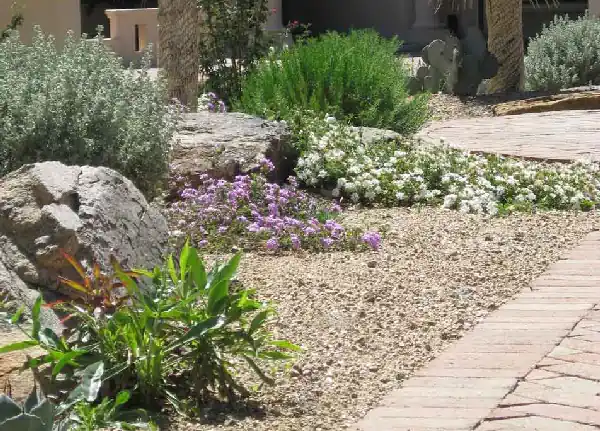
Monsoon season in Tucson can turn a beautiful property into a problem area very quickly. Heavy rain does not just create puddles. It can move soil, overwhelm hardscape, stress planting beds, and send runoff toward structures, driveways, and neighboring lots. For high-value homes and commercial properties, the goal is not simply to “handle water” after the fact. The goal is to shape the site so water moves safely, predictably, and with as little damage as possible.
That is where grading, drainage, erosion control, and runoff planning come together. These are not separate concerns. They are linked decisions that affect how a property performs during a storm and how well it holds up over time in the Sonoran Desert.
Start with the basics: what these terms mean
Grading is the shaping of the land so water flows where it should. Good grading uses slope intentionally. It keeps water away from foundations, directs it toward safe collection areas, and avoids low spots where water can pool.
Drainage is the system or path that carries water away from areas where it can cause damage. This may include surface flow paths, channels, drains, and other features that help move water without creating new problems.
Erosion control means reducing the movement of soil during rain. When water runs too fast or too freely, it can wash away mulch, expose roots, damage edges, and undermine hardscape.
Runoff is the water that flows across the surface during rain instead of soaking into the ground. In a monsoon, runoff can increase quickly, especially on compacted soil, paved areas, and slopes.
Understanding these terms helps property owners make better decisions. A site that looks finished in dry weather can still fail if water has nowhere to go.
Why monsoon-proof design matters more on luxury properties
High-end properties often include features that are especially sensitive to water movement: custom paving, retaining walls, planted courtyards, outdoor living spaces, entry drives, specimen trees, and refined planting beds. These elements can be beautiful, but they also require careful coordination.
A small drainage mistake can have outsized consequences. Water that collects near a foundation can threaten structures. Water that crosses a walkway can stain or shift materials. Water that rushes through planting areas can leave behind ruts, exposed roots, and dead zones. On commercial properties, poor drainage can also affect access, safety, and the long-term appearance of the site.
That is why monsoon-ready landscaping design should be treated as part of the overall architecture of the property, not as an afterthought.
The decision-making framework: where should the water go?
The most important question in drainage planning is simple: where should water move during a storm?
A strong design answers that question before construction begins. The answer depends on several site conditions:
- Topography: Does the property slope naturally, or does it contain flat areas where water can collect?
- Soil behavior: Does the soil absorb water quickly, or does it shed water and create runoff?
- Hardscape layout: Are patios, driveways, and paths creating barriers or directing water into problem areas?
- Building placement: Are structures sitting in the path of water flow?
- Planting strategy: Are beds positioned to help slow water or are they likely to be washed out?
- Neighboring conditions: Does runoff from adjacent lots enter the property?
A professional landscape architect will look at the whole site, not just one feature. That broader view matters because a drainage fix in one area can create a new issue somewhere else.
Grading first, then drainage details
When a site has drainage problems, the instinct is often to add a drain. Sometimes that helps. But in many cases, the better first step is to correct the grading.
Good grading reduces the amount of water that needs to be managed in the first place. It can:
- Move water away from buildings
- Prevent ponding in low spots
- Reduce the speed of runoff
- Support more stable planting areas
- Improve the performance of hardscape over time
If the grade is wrong, even a well-placed drain may not solve the underlying issue. That is why landscape designers tucson and tucson landscape architects often begin with site shaping before selecting drainage components.
Erosion control: protecting soil, roots, and edges
Erosion is one of the most visible signs that a site is not responding well to monsoon conditions. It can show up as bare patches, gullies, displaced gravel, or undermined edges along walls and paths.
Effective erosion control is usually about slowing water down and keeping soil in place. Depending on the site, that may involve:
- Stabilizing slopes
- Using plantings that help hold soil
- Designing transitions between hardscape and planting beds carefully
- Avoiding concentrated water flow across exposed soil
- Protecting vulnerable edges and grade changes
For southwest landscapes, erosion control should also reflect the character of the site. The best solutions are not only functional. They should fit the architecture, the planting palette, and the long-term maintenance plan.
Runoff management should feel intentional, not improvised
Runoff should never look accidental. In a well-designed property, water movement is part of the plan. It may be visible in subtle slope changes, integrated channels, or planted areas that help absorb and slow flow. The point is not to hide water at any cost. The point is to guide it safely.
For tucson az landscape projects, that often means balancing hard surfaces with open, absorbent areas where appropriate. It also means paying attention to transitions: where a patio meets a bed, where a driveway meets a curb, or where a slope meets a foundation.
When runoff is managed well, the site feels more stable in every season. That is especially important for properties where appearance, function, and long-term durability all matter.
A practical checklist for monsoon-ready planning
Before finalizing a design, ask these questions:
- Where does water enter the property during a storm?
- Where does it naturally want to flow?
- Are there low spots where water can pool?
- Is any structure in a vulnerable position?
- Are hardscape edges protected from washout?
- Are planting areas designed to slow or absorb runoff?
- Will the drainage strategy still work if a storm is heavier than expected?
- Is the solution simple enough to maintain over time?
This checklist can help homeowners and commercial decision-makers think more clearly about risk. It also helps keep the conversation focused on performance rather than appearance alone.
A design-forward approach for the Sonoran Desert
In Tucson, landscape design has to respect both beauty and climate. The most successful properties are not the ones that try to fight water with one isolated fix. They are the ones that treat grading, drainage, and erosion control as part of a larger system.
That is the approach many high-net-worth property owners and commercial teams want: clear reasoning, durable materials, and a site that performs well under pressure. Whether the project is a private residence, a hospitality property, or a commercial entry sequence, the same principle applies. Water should be anticipated, guided, and managed with care.
If you are comparing landscaping designers in Tucson or looking for a landscape designer with an architect-led perspective, focus on the quality of the drainage conversation. The right team should be able to explain how the site works, where the risks are, and how the design supports long-term performance.
Monsoon-proof design is not about overbuilding. It is about making smart decisions early, so the property remains functional, refined, and resilient when the storms arrive.
