
Renovating an established yard doesn’t necessarily mean clearing everything away and starting over. In fact, some of the most valuable parts of an older Tucson landscape may already be there: mature trees, native vegetation, patios, walls, boulders, established shade, or plants that have adapted particularly well to the site.
The real challenge is deciding what still belongs, what has stopped working, and how new ideas can be introduced without making the landscape feel patched together.
That is why a successful renovation usually begins by looking at the property as a whole. Instead of replacing individual plants or adding features one at a time, it helps to understand how the landscape functions today and how it should function in the years ahead.
Start by Understanding What Is Already There
An established landscape can tell you a great deal about the property.
Over time, it becomes easier to see where afternoon heat is most intense, where water collects after a storm, which plants thrive, where privacy is lacking, and which parts of the yard rarely get used. Mature vegetation may also provide shade and habitat that would take years to recreate.
For that reason, the first stage of a renovation should be less about removing things and more about evaluating them.
Before making major design decisions, it helps to consider:
- Mature trees and established plants worth preserving
- Existing irrigation and how well it serves the current planting
- Patios, walkways, walls, steps, and other hardscape
- Views that should remain open or could be improved
- Areas where more privacy or screening would be useful
- Changes in grade and existing drainage patterns
- Sun and shade throughout the day
- How people currently move through and use the property
This kind of site assessment is already an important part of Landscape Design West’s broader landscape design process. Understanding existing conditions makes it possible to build a new plan around the strongest parts of the property rather than automatically treating the site as a blank slate.
Decide What Is Worth Keeping
One of the most important decisions in any renovation is what not to change.
A healthy mature tree, for example, may provide shade, scale, wildlife value, and visual character that cannot quickly be replaced. Existing native boulders or other site materials can also help a redesigned landscape remain connected to its surroundings.
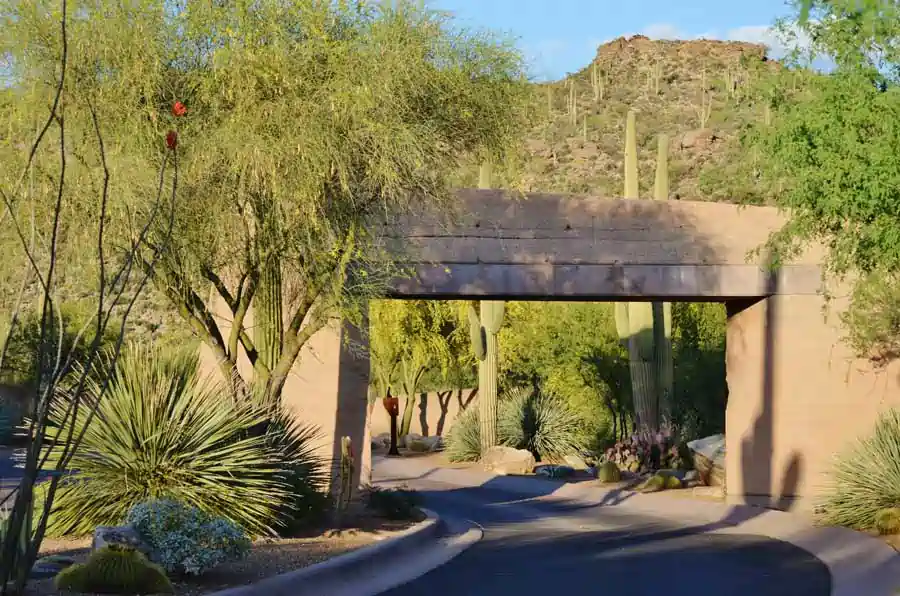
At Canyon Pass Entry at Dove Mountain, the renovation worked with existing native boulder work and mature trees instead of removing them. Specimen succulents were introduced to add color, texture, and year-round interest while making better use of elements that were already well established.
That approach often produces a more interesting result than simply replacing old with new. It allows a landscape to evolve while retaining some of the maturity and character it has developed over time.
Identify What Is No Longer Working
Of course, preserving existing features does not mean everything should stay.
Landscapes change, and so do the people who use them. Plants may become overgrown, views may disappear behind mature vegetation, irrigation may no longer match the planting, or spaces designed years ago may no longer suit the way the owners use the property.
Sometimes the problem is less obvious.
A landscape may be healthy but feel disconnected from the architecture. A front entry may lack definition. A patio may receive too much afternoon sun. Planting may have been added gradually over the years until the overall composition starts to feel cluttered or inconsistent.
Renovating the yard creates an opportunity to look at those issues together instead of treating each one as a separate fix.
At Canyon Pass Modern House, for example, the work included opening views that had previously been blocked, screening a road for greater privacy and sound reduction, introducing specimen succulents, and reworking an existing water feature with larger native boulders from the property. A strategically placed shade tree also helped soften strong light near a kitchen window.
These are very different concerns, but they make more sense when considered as parts of one landscape rather than as unrelated improvements.
Reconsider How the Outdoor Spaces Are Used
A renovation is also a good time to ask whether the layout of the property still makes sense.
A backyard designed many years ago may not include the spaces homeowners want today. There may be opportunities for a more comfortable seating area, better outdoor dining, improved access to a pool, clearer circulation, or a stronger connection between the house and garden.
In other cases, the spaces already exist but could work together more effectively.
The Desert Modern project is a good example of an established property being reconsidered as a complete composition. The redesigned landscape introduced a new entry courtyard, adjusted planting and grade relationships, and organized the backyard around a pool, grilling and dining area, kitchen garden, shade, and mountain views.
The point is not to add as many features as possible. What matters is whether those features belong together and make the property more comfortable and intuitive to use.
Review Irrigation and Water Use at the Same Time
Updating an older landscape is also a good opportunity to take a fresh look at water use.
Established yards may contain plants with very different irrigation needs connected to the same system. Emitters may no longer be positioned correctly as plants have matured, or parts of an older irrigation layout may still be serving areas that have changed over time.
Tucson’s dry climate makes it especially important to consider planting and irrigation together rather than treating them as separate decisions.
That may mean preserving plants that are already well adapted to the property, replacing higher-demand material where it makes sense, reorganizing irrigation zones, or finding opportunities for rainfall to support planted areas more effectively.
These same decisions are central to drought-tolerant landscape design, where plant selection, placement, and irrigation are considered together rather than as separate parts of the yard.
The goal is not simply to use as little water as possible. It is to use water thoughtfully and to create a plant palette that makes sense for the site, the climate, and the way the landscape is intended to look over time.
Use New Planting to Strengthen the Existing Landscape
One common mistake when updating an older yard is to think mainly in terms of replacing plants.
Planting design is usually more successful when it begins with the overall composition.
New plants can reinforce focal points, repeat important forms or colors, soften hardscape, frame views, provide seasonal interest, or connect parts of the yard that currently feel unrelated.
Specimen succulents can introduce strong architectural forms. Flowering shrubs and perennials can bring seasonal color. Trees can add shade and vertical structure. Lower-growing plants can preserve important views while adding texture closer to the ground.
The right choices depend on more than drought tolerance. Scale, location, sun exposure, maintenance, color, texture, and the architecture of the property all influence how well a planting design works.
The finished result should feel like one landscape, not an older garden with a collection of new plants inserted into it.
Consider Privacy, Shade, Lighting, and Views Together
Some of the most valuable improvements to an established property are highly specific to the site.
A homeowner may want more privacy without losing a mountain view. An outdoor seating area may be pleasant in winter but uncomfortable during warmer months. Mature trees may provide useful shade in one location while obscuring an important view somewhere else.
These decisions influence one another.
A screening plant placed for privacy will also affect what can be seen from inside the house. A new shade tree may change the conditions for nearby planting. Lighting can make a remodeled patio more useful after sunset, but fixture placement should relate to paths, architecture, planting, and focal points.
Looking at these elements together is one of the main advantages of developing a complete plan before making changes.
Renovation Does Not Have to Happen All at Once
Having a comprehensive design does not mean every improvement has to be completed at the same time.
On a larger property, work can be organized into coordinated phases. Major decisions involving circulation, drainage, hardscape, irrigation, or utilities can be addressed first, followed by planting, lighting, furnishings, or other details as appropriate.
What matters is having a whole-site landscape plan that establishes where the property is ultimately going.
Without a broader plan, individual improvements can create problems later. A patio might occupy space needed for drainage. New planting may have to be moved when another feature is added. Irrigation might need to be rebuilt more than once.
Planning the property as a whole allows the work to happen gradually without losing the relationship between the different areas.
When Is It Time to Renovate a Landscape?
There is no particular age at which a landscape suddenly needs to be redesigned. Some gardens continue to function beautifully for decades, while others begin showing problems much sooner.
It may be worth considering an update when:
- Important plants have outgrown their original locations
- The landscape no longer complements the architecture
- Views or entrances have become obscured
- Privacy has become an issue
- Outdoor areas are uncomfortable or rarely used
- Irrigation no longer matches the planting
- Hardscape feels disconnected or dated
- The property has changed because of remodeling, a new pool, or an addition
- Maintenance requirements no longer fit the owner’s priorities
- The yard feels like a series of separate improvements rather than one cohesive design
Sometimes only one part of the property needs attention. In other cases, solving one issue reveals that several areas are connected.
That is why the first question does not necessarily need to be, What should we replace?
A more useful question is, What does this property need now?
A Thoughtful Landscape Renovation Starts With a Plan
Established landscapes have something new landscapes do not: time.
Plants have matured. Shade patterns have developed. The property has revealed where water moves, which areas are comfortable at different times of day, and how people actually use the outdoor spaces.
A thoughtful renovation makes use of that information.
By keeping the elements that still work, correcting those that do not, and approaching new improvements as parts of one overall design, an established Tucson landscape can evolve without losing the qualities that made it worth preserving in the first place.
Landscape Design West approaches these projects through site analysis, client priorities, customized design concepts, and detailed landscape planning. The aim is not simply to make an older yard look newer, but to create an outdoor environment that feels more resolved and works naturally with the property, its architecture, and its Sonoran Desert setting.
